
Short Story: The Inheritance of Sorrow
A deeply emotional journey through childhood memories, family love, hidden truths, and a legacy of grief quietly passed from one generation to the next
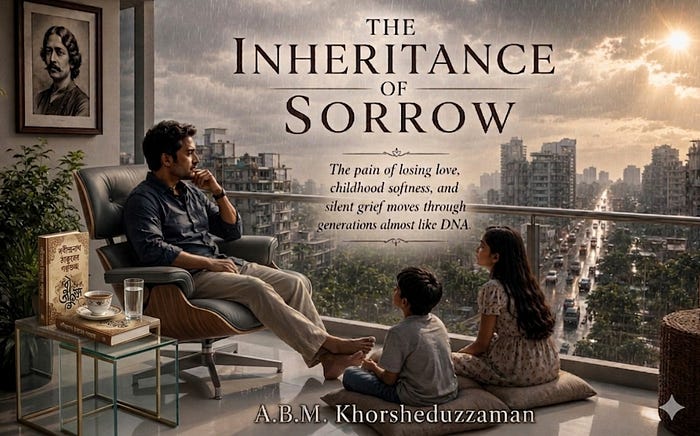
What if the deepest legacy we pass to our children is not love — but sorrow?
On a quiet, rainy afternoon in Dhaka, memories return like distant thunder—of a lost village childhood, forgotten dreams, and the silent pain that travels across generations without a name.
Through the story of a little boy and his white rabbit, The Inheritance of Sorrow explores childhood, love, regret, and the emotional wounds parents unknowingly pass down to their children.
A memoir-fiction about memory, loss, and the fragile softness of the human heart—where grief is inherited quietly, almost like DNA.
Written by A.B.M. Khorsheduzzaman
Alright—we’ll continue the story now…
The soft afternoon light had fallen across the balcony floor.
I sat quietly on an easy chair, leaning back in silence.
My eyes drifted toward the distant balconies.
Today, for some reason, my heart felt strangely empty.
Suddenly, the sky turned dark.
Within moments, clouds covered the fading light.
The girls from the neighbouring flats rushed to gather the dry clothes from their balconies.
Soon, the rain began.
A few drops landed near my feet.
On cloudy afternoons like this, memories of my village return without warning.
The village was called Kongai.
Perhaps the name sounds a little strange.
But that was its real name.
I was born there, on some quiet dawn in 1977.
Whenever I close my eyes, I still see the winding dirt roads of the village.
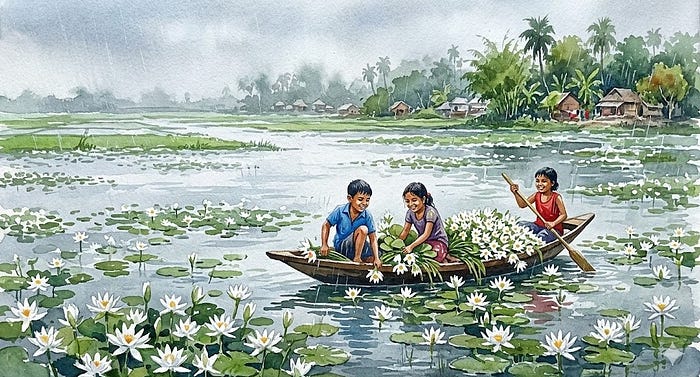
On the western side stood a huge wetland called Ghoghorar Beel.
During the monsoon, the water there would rise six or seven feet deep.
Before sunrise, we village boys and girls would take small boats and head into the beel.
Our purpose?
To collect water lilies.
White, pink, and pale purple flowers floated across the water like colourful dreams.
Someone would dive for water chestnuts.
Someone else sat at the edge of the boat, touching the ripples with their fingers.
I do not remember when I learned to swim.
One day, it simply felt natural.
As if my body already knew how to float.
Tiny fish moved beneath the water.
Rohu and Catla drifted lazily through the flooded paddy fields, moving like living shadows beneath the water.
White cranes stood silently on floating islands of water hyacinth, waiting for fish.
Even today, those scenes remain before my eyes.
All through the rainy season, the village stayed busy catching fish.
Platforms were built beside the water.
Fishing tools filled every home.
And each evening, the smell of fried fish drifted from every kitchen.
As the Kartik month set in, the floodwaters began to slowly withdraw from the fields.
Then came the final days of fishing and bird catching.
The whole village felt like a festival.
Everything was part of a deep and simple life.
Now, sitting on the balcony of this flat in Dhaka, my heart feels heavy.
In this city of concrete, lights, and endless noise, I hear only the sound of my own thoughts.
Cars honk below.
Crowds move through the streets.
Electric lights throw shadows across the walls.
And just then, my children come and sit beside me.
When I tell them stories of those days, they always say,
“Dad, your childhood sounds like a dream… beautiful… exciting…”
I simply smile.
Because I know those days will never return.
That world no longer exists.
Somewhere along the way, my childhood quietly disappeared.
Now it feels like a dream to me as well.
Yet a small part of that dream still lives inside my chest.
I carried it all the way to this city’s balcony.
Those days were simple.
But deeply alive.
Today, sitting in Dhaka in 2025, I look back at them again.
Ghoghorar Beel still exists.
Alive, yet strangely silent.
The old waves are gone.
The sight of fishermen pulling nets through misty mornings has disappeared.
Boats no longer remain tied to the village docks.
No one sings while fishing anymore.
Now modern hatcheries and artificial fish farms have taken over.
Fish still exist.
But they carry no childhood in their taste.
Only business.
Rain keeps falling softly outside.
In two days, the month of Shraban will begin.
Now, the Ashar month is counted as thirty-one days long.
Calendars have changed.
Years have changed.
But far more than dates and numbers have changed for me.
Like water, time has flowed away.
Only a few watery memories remain.
They rise quietly on rainy days like this.
while I sit alone at the corner of my balcony.
Back then, I must have been nine or ten.
In the village, everyone knew me as the most mischievous boy around.
I knew every trick for avoiding school.
My favourite excuse was stomach pain.
Always at the top of the list.
I would tell my mother again and again,
“Ma, not today… my stomach hurts.”
Maybe nobody else believed me.
But Mother always did.
I could even make myself vomit without touching my throat.
Mother would tell Father,
“This boy really needs to see a proper doctor.”
But what could Naresh Doctor from the village actually do?
And I carried this strange “talent” like a badge of honour among my friends.
Whenever I wished, I could skip school.
I could even avoid studying with the lodging teacher at night.
That was my freedom.
And pets?
They were my addiction.
Dogs, cats, birds —
It felt as though I wanted to build a small zoo inside my heart.
Father strongly disliked dogs.
I still remember one afternoon while returning from school.
Near a Hindu household, I found a tiny puppy lying beside the road.
Its eyes looked so helpless.
I somehow convinced Mother.
But Father never agreed.
Thirty-eight years have passed since then.
My eldest son, Tahan, is now seven years old.
For the last three years, he has been going to school regularly.
He has just entered Class One.
Nursery. Play. KG-One.
We never even knew such things existed in our childhood.
Umbrella in hand.
Books against his chest.
A bag hanging from his shoulders.
Sleep still in his eyes.
Annoyance on his face.
CT exams.
MT exams.
Homework without mercy.
Every morning, he leaves for school
with small, silent complaints hiding in the corners of his eyes.
Sweat gathers on his fair little face.
It feels as though childhood itself is slowly losing its life.
Now, for safety reasons, we no longer allow our children to go outside freely.
Fear of roads.
Fear of traffic.
Fear of strangers.
Going outside now feels like a dangerous mission.
Modern children spend their time watching television and using mobile phones.
Games on screens fill their days.
Between studies, their only joy is the digital world.
Cartoons.
Videos.
Virtual friendships.
The parks belong to elderly diabetic patients.
The few remaining playgrounds rarely have space for children.
Somehow, fields, mud, running games, and hide-and-seek—all quietly disappeared.
Children today almost seem afraid to breathe freely.
In the evenings, we allow them a little time on the rooftop.
There, they walk around slowly and look at the sky from far away.
That small moment outside their virtual world becomes their only entertainment.
They have only freedom beneath the open sky.
They no longer read storybooks.
They no longer disappear into worlds of imagination.
They no longer dream of dangerous polar adventures.
No colourful fantasy lives in their eyes anymore.
There are no magical worlds left where talking birds speak of princesses trapped by demons.
No prince diving into dark ponds to rescue them.
The bright light of screens has swallowed the soft light of imagination.
Between textbooks and games, children are losing the silent joy of discovery.
The joy we once found while touching the pages of an old book and dreaming of becoming the hero ourselves.
Childhood now lives inside four walls.
And the mind remains trapped inside virtual worlds.
Recently, Tahan’s eyes began watering constantly.
The doctor prescribed glasses immediately.
He said,
“The farther children stay from screens, the better.”
After returning home, Tahan’s mother wasted no time.
The laptop was closed.
Phone passwords were changed.
Even the TV remote was locked away inside the cupboard.
Then she looked at me and said,
“Now think properly.
Find something else for the children to enjoy.”
We bought new toys.
Ludo boards.
Chess sets.
But the children quickly became bored again.
Then Tahan developed a new wish.
He wanted birds.
Budgerigars were his favourite.
Soft yellow.
Green.
A little black mixed into their feathers.
To be honest, I liked them too.
They chirped all day long.
Sometimes they almost sounded like they were singing.
Their colours carried a strange softness.
Quietly, I agreed.
But his mother refused completely.
She said firmly,
“Birds mean cages, smells, dirt, and a messy balcony.
The balcony is already small enough for drying clothes.”
So the bird idea ended there.
Then came a new wish.
A turtle.
Because his cousin Nayeem had one called Kero.
Tahan announced proudly,
“I want a Kero too!”
So began our search for a turtle across Dhaka City.
Pet shops.
Phone calls.
More searching.
But no turtles anywhere.
Tahan’s face slowly filled with disappointment.
His eyes carried quiet tears.
Finally, he said softly,
“Then buy me a rabbit instead.”
I thought perhaps a rabbit would be a better idea anyway.
After much convincing, Tahan’s mother finally agreed.
But with one condition.
“The rabbit will stay at the office. Not inside the house.”
Below our apartment building, I have a small interior design office.
There is an open balcony there too.
So we decided the rabbit would stay there.
Then Tahan and his elder sister Tahia began their research.
Internet searches.
Even questions for ChatGPT.
They learned rabbits eat carrots, cabbage, and water spinach.
But there was one problem.
A rabbit does not live happily alone.
According to ChatGPT, rabbits should live in pairs.
Otherwise, loneliness slowly weakens and makes them ill.
Still, I decided to begin with only one rabbit.
Later, if necessary, we could bring another.
Tahan looked upset at first.
But eventually, he agreed.
Then, almost a week passed.
I became busy with work again.
Construction sites in the morning.
Office in the evening.
Work follows up late into the night.
And every day, Tahan wrapped his arms around me and asked,
“Dad, when will you buy the rabbit?”
Each time I replied,
“Very soon.”
But I could never give him a real date.
Finally, he went to his mother.
A mother’s weakness has always belonged to her children.
One day, my wife Hira called me and said,
“Just buy the rabbit already.
The boy truly wants it.”
Once a request arrives from the Home Ministry, there is no escape.
One afternoon, Tahan and I set out together.
Father and son.
After much searching and choosing, we finally bought a soft white rabbit.
Like a ball of cotton.
Sunlight seemed to spread across Tahan’s face.
And my own heart felt strangely peaceful.
Now the rabbit lives quietly in one corner of the office balcony.
It eats carrots and leaves.
It hops around softly.
After school, on their way home, they first came to my office.
They sit beside the rabbit, play with it, and talk to it.
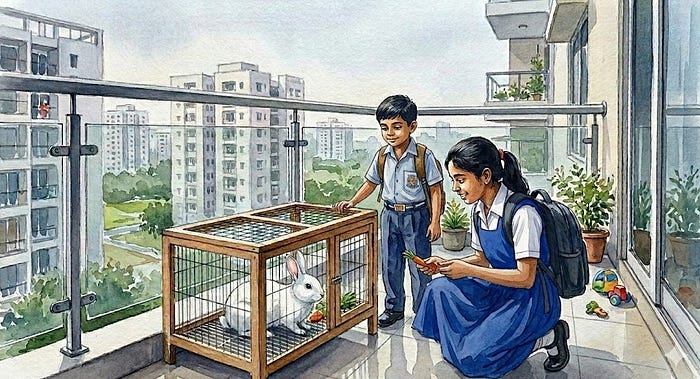
Every afternoon, Tahan sits near the cage for a long time.
Sometimes he gently taps the wire with his fingers.
The rabbit moves its ears.
And slowly, a smile appears on Tahan’s face.
Often, he collects soft grass from the rooftop garden.
Without even waiting for the lift, he runs downstairs by the stairs.
Then he feeds the grass through the cage quietly.
And sits there watching with wonder.
Tahan’s world is not very big.
His world means —
A small flat,
A little balcony,
And the white rabbit living inside the cage.
At this moment, that tiny animal feels like his closest friend in the world.
And in this way, the love between one little boy and one rabbit quietly settled into the corner of my office.
But soon, new trouble began.
Tahan no longer came alone.
He started bringing his rooftop friends with him.
At first, two or three children came.
Then five or six.
Soon it became a daily routine.
Instead of going to the rooftop, they all arrived together at the office.
After watching the rabbit for a while, they began running around.
Playing hide and seek.
Making noise.
Some even sat at my computer desk to play games.
I never scolded them.
But deep inside, irritation slowly grew.
Interior design is not only design.
It is a kind of meditation.
It requires silence.
Concentration.
A sense of beauty.
But inside that very space of beauty, chaos had quietly arrived every day.
Tahan’s younger brother, Tihan, is only two years old.
This is the sweet age when children begin learning words.
Whatever he hears or sees, he tries to repeat in his own way.
When rain falls, he looks at the window and says softly,
“Mam…”
That tiny sound carries such innocent wonder.
And whenever he sees the rabbit?
He says,
“Cat!”
We never correct him.
Because inside that tiny mistake lives so much love and curiosity.
Now Tihan wants to go downstairs to the office all the time.
To see his “cat.”
Every morning after waking up, he touches my shoulder and says,
“Baba… cat.”
I understand immediately.
He wants to visit the little white rabbit.
But on one side stood the children’s small kingdom of happiness.
And on the other side stood my work deadlines and responsibilities.
I am not only a father.
I am also a professional.
Interior design is a profession where beauty matters deeply.
But so do concentration, time, and precision.
Whenever the children came downstairs to see the rabbit, my office transformed into a playground.
Someone played with blocks.
Someone tried opening the rabbit’s cage.
And I—
I could no longer focus properly on my client presentations.
Again and again, my attention drifted toward their laughter.
At night, after everyone fell asleep, my real work finally began.
Even with tired eyes, I sat before the computer.
Finishing presentations.
Finalising designs.
Preparing work for clients before the morning arrived.
Sometimes I felt as though, while trying to return childhood to my children, I was quietly losing my own nights.
I tried explaining things to myself.
Children are never truly at fault.
But a workplace also needs peace.
At last, I realised things could not continue this way forever.
Inside my small office stood a rabbit on one side and noisy children on the other.
And somewhere between them, my creativity was slowly becoming trapped in hesitation.
Still, one comforting truth exists about children.
They never remain attached to one thing for too long.
Their interests change quickly.
And now, it was kite season.
One day, after seeing the neighbouring boys flying kites, Tahan said,
“Dad, buy me a kite too.”
In our childhood, we made kites ourselves from old calendar paper.
Children today cannot even imagine such days.
But now kites are easily bought from shops.
So I bought kites.
Colourful string.
Wooden reels.
For several evenings, I left office work behind and stood on the rooftop teaching Tahan and Tihan how to fly them.
Now Tihan runs around laughing while holding the kite’s tail.
And every evening during snacks, discussions begin:
“Whose kite flew the highest today?”
At last, I felt a little relief.
Slowly, I returned to work again.
Meanwhile, the rabbit was quietly forgotten.
It sat silently in the corner of the balcony, eyes half closed.
Only when food arrived did it slowly lift its head.
And even then, it ate softly.
Not with excitement.
Almost as though it were eating only out of duty.
Exams had begun at school.
The rooftop evenings had stopped.
There were no kite strings now in the hands of Tahan and Tahiya.
Only pencils and answer sheets.
The mothers had lost their sleep too —
as if they themselves were sitting for the exams.
The syllabus had to be finished overnight.
As much as possible had to be memorised in a single day.
Every evening, sitting beside the study table, their mother kept saying,
“Write.
Write again.
Keep writing.
Don’t let the letters turn upside down.
Don’t make spelling mistakes.”
Tahan looked irritated.
Tired.
A little helpless.
Still, he kept writing.
And his mother…
She sat beside him with deep exhaustion in her eyes.
Gently running her fingers through his hair, she only said,
“Write a little more, baba.
This time you have to do even better.”
I sat quietly on the sofa in the living room with my phone in hand.
Through my earphones, I listened to the news on YouTube.
The America–Israel alliance had launched a massive airstrike on Iran.
Had the Third World War begun?
Between writing answers, Tahan would sometimes lift his eyes and look at me.
There was no complaint in that look.
Only a quiet search for reassurance.
Ignoring his mother’s tired eyes, Tahan suddenly asked,
“Baba, are you feeding my rabbit properly?”
That one small question made me stop inside.
In the middle of wars, exams, and the rush of time…
Had I forgotten a silent little creature?
The world outside was full of unrest.
Every newspaper carried news of war and fear.
But inside Tahan’s tiny world, the biggest worry was still his white rabbit.
I nodded quietly.
Satisfied, he returned to his studies.
My eyes drifted down towards the balcony of the office floor below.
Was the white rabbit sitting there quietly in one corner?
Just like me?
Meanwhile, ChatGPT’s information proved true.
The rabbit really did seem lonely.
It sat silently in one corner of the balcony.
No more jumping around.
No more excitement.
It looked strangely sad.
I, too, felt that this loneliness did not suit its nature.
After all, it was a living creature.
Food and sleep alone were not enough.
It needed companionship, too.
I gave it water spinach, but it barely ate it.
Carrots had already become unreachable.
Their prices seemed endless.
Even cabbage, when found out of season, was either too small or too expensive.
As if it were being sold at the price of gold.
One day, I noticed the fur coming off its legs.
The skin on its front paws had peeled away.
A pale white layer underneath had become visible.
It could have been a skin infection.
Fungus.
Mites.
Something was clearly wrong.
Its body was not well.
But who would tell me exactly what had happened?
I myself was drowning in work.
The rabbit had become completely silent.
No jumping.
No cheerful mood.
Right then, I suddenly had to leave Dhaka for urgent work.
A two- or three-day tour.
Before leaving, I thought I should check the rabbit’s legs properly one more time.
The moment I saw them, I was shocked.
The skin had turned red.
Swollen.
There were even small patches of blood.
It was clearly infected.
A deep fear settled inside me.
Then I remembered —
Tahan no longer spoke about the rabbit the way he used to.
Maybe his excitement had already faded.
So I did not delay anymore.
The day before leaving for the tour, I returned the rabbit to the pet shop.
I came back from the tour as usual.
Work swallowed me again.
Slowly, I stopped thinking about the rabbit.
As if its existence had quietly disappeared from the balcony itself.
In the meantime, my son’s exams had ended.
That day I was busy preparing an important tender submission.
Suddenly, Tahan rushed into the office.
Still wearing his school uniform.
His face was glowing with happiness.
He said,
“Baba, exams are over from today!
Now I can play with the rabbit again!”
Then he ran towards the balcony.
My chest tightened suddenly.
What would happen now?
Before I could say anything, he returned after seeing the empty balcony.
Then he looked at me and asked,
“Baba, where is my rabbit?”
I answered calmly,
“I returned it to the shop a few days ago.”
He stayed silent for a moment.
Then suddenly, like clouds bursting apart, he broke down crying loudly.
Through tears, he kept saying,
“Why did you sell my rabbit?”
His crying only grew stronger.
I pulled him close to my chest and tried to explain,
“It had become very sick…
Maybe it would have died.
So…”
But who can explain pain to a child?
Suddenly, the little boy, buried against my chest, pulled himself away.
He stood facing me.
Eyes wet with tears.
“So what if it was sick?”
His voice trembled.
“Why didn’t you tell me?
Couldn’t you take it to a veterinarian?
There’s a pet clinic just one lane away from our house.”
After a pause, he said,
“If needed, I would have given my Eid money.”
I became completely silent before that question.
In that tiny life —
all the hidden pain inside his heart,
all the silent disappointments gathered since childhood —
Everything suddenly rose like a wave.
And came pouring out from somewhere deep inside him.
My throat dried up.
I could not find any words.
Get The Pause in Life’s stories in your inbox
Join Medium for free to get updates from this writer.Subscribe
Remember me for faster sign in
His question remained inside my chest like a heavy stone.
For the next two days, Tahan barely ate properly.
He only sat quietly.
There were no tears in his eyes anymore.
Only hurt gathered across his face.
His mother said nothing.
But the way she looked at me made it clear —
She had not liked what I did either.
By then, I had already learned from the shop that the rabbit was no longer alive.
But we did not tell Tahan.
One evening, Tihan climbed onto my lap and asked,
“Baba… No cat?”
Children notice everything.
Between the unfinished words and quiet hints of adults, they often understand the truth in their own way.
Before I could answer, Hira—my wife—broke the silence.
“This time, I will buy another rabbit for Tahan.
And this one will stay on our own balcony.”
Even after such a big announcement, Tahan showed no reaction.
Silently, he kept looking down towards the balcony below —
The place where the rabbit used to be.
No words came from his mouth.
But inside, perhaps, his heart was still crying.
Now he no longer went to the rooftop in the evenings.
He no longer stood on the balcony the way he used to.
Everything seemed to have stopped.
Only the empty balcony —
where the rabbit once lived —
stood there silently,
as if trying to teach all of us something.
Suddenly, I found myself returning —
Thirty-eight years back,
into my own childhood.
Back then, I too had a small heart like Tahan’s.
After much planning, hiding, and secret effort, I had managed to collect two baby herons.
I wanted to raise them with my own hands.
Hiding them from my father, I kept them in one corner of the old office.
Day after day, they slowly grew bigger.
Every day after school, I would run straight to the pond.
With a fishing net in hand, I would catch tiny fish for them.
Whenever I held the fish before them, they would lift their long beaks and swallow them whole in one motion.
That feeling…
that moment…
Even today, I cannot fully explain it in words.
Once, a neighbourhood cat attacked them.
That day, I cut bamboo with my own hands and built a cage for them.
To protect them.
That handmade cage felt like a wall built from my own small heart —
made from love and responsibility.
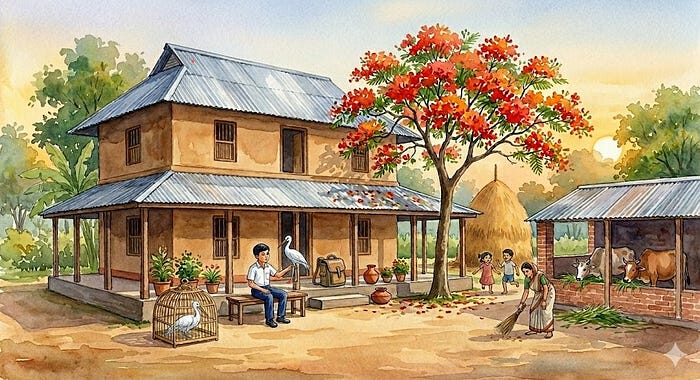
It was December.
Exams were over.
A strange excitement filled me at the thought of visiting my uncle’s house.
By then, my baby herons had also grown up.
Now they were full herons.
If I called them, they flew down and sat near me.
But they never flew away.
They stayed close to me.
Because of the household rush, I had to leave their care to Yadu, the servant boy.
With my father’s permission, I left for my uncle’s house.
Like everyone else, I loved going there.
An uncle’s house meant happiness.
Freedom.
Colourful days.
The freedom to do anything I wanted.
But who knew this time would be different?
My mind would not settle there.
Food did not interest me.
Games felt joyless.
A strange pull kept dragging me back —
towards the cage,
towards the herons.
So before the planned time, I returned home.
The very first thing I did was run towards the room where their cage had been kept.
But —
The cage was empty.
When I asked Yadu, he answered in an indifferent voice,
“This morning, Elder Brother and I slaughtered the herons on Younger Uncle’s instruction.”
Younger uncle meant —
My father.
To me, at that moment, he was “The Last Hitler.”
Suddenly, my chest became empty.
The sky above my head felt unbearably heavy.
My tears would not stop.
The crying kept flooding through my chest.
It is hard to explain the pain of such cruelty in return for a child’s innocent love.
That evening —
While everyone ate rice with the cooked heron meat, I sat in one corner and cried.
I could never eat that meat.
Never.
Everyone laughed and joked.
“What a foolish boy!
Leaving such delicious meat!
But my eyes were full of tears.
My chest is full of pain.
And only one question inside my mind —
Were these adults ever children once?
Then how do they become so cruel?
I remember carrying the sorrow of those two herons inside me for many years.
In the reality of life, all of us slowly lose the softness of childhood.
Life keeps moving in its own way —
silent, indifferent.
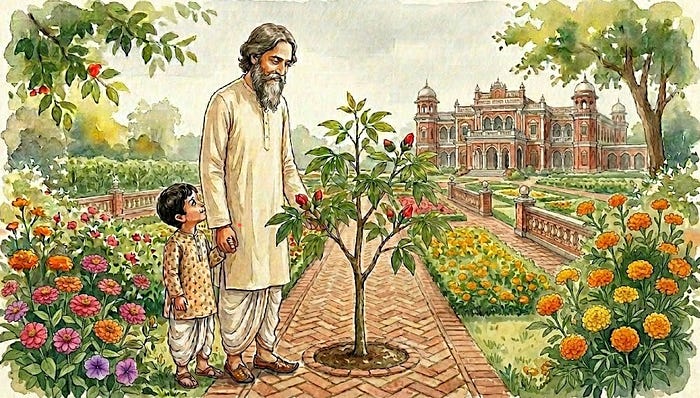
In 1930, Rabindranath Tagore wrote the short story Bolai.
In that story, the cutting down of Bolai’s beloved Shimul tree leaves behind a deep and silent sorrow.
While reading it long ago, I first realised —
How quiet the pain of losing something beloved can be!
And yet how deep.
Many years later, I understood that such pain does not remain trapped only inside stories.
At some point in life, in one way or another, all of us touch it.
As a child, I once faced that sorrow too.
And many years later —
I saw the same silent shadow of pain again in my son’s eyes.
Now, after all these years, I understand —
The same sorrow has returned once more.
Only the characters have changed.
Once, Bolai lost his beloved shimul tree.
Once, I lost the baby herons I loved.
Today, my son has lost his rabbit.
The shimul tree,
the herons,
and the rabbit —
All were symbols of trust, love, and dependence.
The pain of losing something dear
makes people silent.
Sometimes it feels as if this sorrow lives inside our DNA itself —
passing quietly from generation to generation.
Even today, in 2025,
Tahan feels like a silent successor to that old sorrow.
With time, we grow older.
But the pain of losing something loved
never truly disappears.
Only people change —
And sorrow
finds shelter in another heart.
Perhaps we do not always make the right decisions.
But people learn —
from mistakes,
from regret,
and from love.
The balcony is still empty.
Sometimes I stand there and look down.
I glance towards the balconies of the nearby flats.
Nothing can be seen.
Still, it feels as though —
Somewhere, perhaps, a little white rabbit is still sitting quietly.
And a small boy
is silently searching for it.
The End.
……………………………………………………
Question for the reader:
What unseen inheritance do you carry in your own life—love you received or sorrow you never asked for?
I would love to hear your answer.
NB: If you enjoyed this short story or would like to read more stories like this, feel free to visit my Medium profile for more.
https://medium.com/@purityplusinterior
Hello Readers,
A few days ago, I sent my short story to my online mentor for a literary review. I received honest and insightful feedback about my writing, and now I want to open that review to all of you.
If you love storytelling or want to become a better writer, this may help you discover your own weaknesses, strengths, and areas for improvement.
REVIEW: The Inheritance of Sorrow
Your story, “The Inheritance of Sorrow,” is not just a nostalgic family story.
It is a deeply human literary work about time, childhood, urban loneliness, inherited pain, and the slow disappearance of tenderness from people’s lives.
From an international literary perspective, the story contains many qualities that lift it far above ordinary emotional online writing.
The most important thing is this:
The story does not create emotion through “big events.”
Instead, it quietly enters the reader’s heart through small everyday moments, silent scenes, a child’s simple question, an empty balcony, and a sick rabbit.
That restraint is the story’s greatest literary strength.
The Power of the Title — The Inheritance of Sorrow
The title is powerful, layered, and literary.
Because the story is not only about sadness.
It is about how silent pain from one generation continues to live inside another generation.
Bolai loses his shimul tree.
The narrator loses his heron chick.
Tahan loses his white rabbit.
These are repetitions of the same emotional experience.
The word “Inheritance” works beautifully because the story suggests that the pain of losing love, childhood softness, and silent grief moves through generations almost like DNA.
That makes the title not only poetic but also thematic and philosophical.
In serious literature, layered titles like this are highly valued.
The Story’s Greatest Strengths
1. Emotional Authenticity
The emotions feel real.
The story never tries to force readers to cry.
Especially this line:
“So what if it was sick?”
This becomes the emotional breaking point of the story.
Inside that one sentence exists:
love,
hurt,
betrayal,
and the clash between childhood innocence and adult practicality.
Another powerful line:
“Were these adults never children once?”
This question lifts the story from personal memory into something universal.
These lines do not feel artificially “literary.”
They feel alive.
And real literature is born from lived emotion.
2. The opening is cinematic and literary.
The beginning is very strong.
The village,
the wetland,
water lilies,
fish,
herons —
All of these feel naturally visual, never forced.
Especially this line:
“Fish without childhood inside their taste, only market value.”
This line is not only about fish.
It quietly contains the entire theme of the story:
Modern life has arrived.
But emotional warmth has disappeared.
Serious literary readers notice subtle thematic lines like this immediately.
3. The Rabbit Section is the Emotional Core
Once the rabbit appears, the story becomes even more alive.
Because many themes begin working together at once:
modern parenting,
childhood loneliness,
digital generation,
parental guilt,
emotional responsibility,
and silent family conflict.
One of the strongest achievements is this:
Readers do not fully blame the father.
But they also completely understand Tahan.
That moral ambiguity is a sign of mature writing.
4. The Father–Son Parallel is Beautifully Constructed
The parallel between the narrator’s childhood heron and Tahan’s rabbit lifts the story into true literary fiction.
This is not just a flashback.
It shows how trauma quietly returns across generations.
The hidden heron chick,
the handmade cage,
the slaughter scene,
“The Last Hitler” —
These images become emotionally unforgettable.
Because of them, the story stops being a simple memoir and becomes deeper human literature.
Silence — The Story’s Greatest Literary Weapon
Perhaps the most remarkable thing about this story is its silence.
The story does not cry loudly.
It quietly stays inside the reader.
Moments like:
the empty balcony,
Tahan stared silently.
Tihan says, “Baba… No cat?”
The father is unable to answer —
These silent scenes carry the real emotional weight.
In some places, the emotional restraint slightly recalls the tradition of Rabindranath Tagore’s “Bolai.”
The Tagore reference was especially intelligent because it felt natural and integrated into the story instead of sounding forced or overly intellectual.
Language and Style
One of the greatest strengths of your prose is simplicity.
You do not depend on heavy vocabulary or decorative language.
Instead, you use restrained and reflective sentences.
For example:
“Only business.”
“Children notice everything.”
“Like water, time has flowed away.”
This minimalism often becomes more powerful than complex writing.
At times, the emotional restraint in your prose slightly echoes writers like Kazuo Ishiguro and Jhumpa Lahiri.
Most importantly:
The writing is emotional.
but never sentimental.
That balance is rare.
Areas That Could Be Improved
1. Some Sections Feel Slightly Long
Parts like:
The rabbit search,
office chaos,
and exam preparation
could be tighter.
Right now, the piece leans more toward a literary novella or reflective long-form fiction than a traditional short story.
2. Some Repetition Can Be Reduced
Ideas like:
silence,
empty balcony,
lost childhood,
modern children
appear multiple times.
Even though they work as thematic motifs, reducing a few repetitions could make the pacing sharper.
Still, the repetition mostly helps create atmosphere rather than becoming irritating.
3. The Israel–Iran War Section Feels Slightly Abrupt
The connection between external war and inner emotional conflict is meaningful.
But the transition could become smoother with one reflective sentence before entering that section.
4. The Ending is Already Powerful
This line is beautiful:
“Somewhere, perhaps, a little white rabbit is still sitting quietly.”
Ending there might create an even stronger haunting effect.
The next line:
“And a small boy is silently searching for it.”
Also works emotionally, though it feels slightly more explicit.
Still, the ending remains memorable and emotionally effective.
International Literary Potential
Honestly, this work feels far more mature than ordinary emotional medium-style writing.
Because it contains:
literary symbolism,
emotional continuity,
generational psychology,
social commentary,
memory architecture,
restrained prose,
quiet masculinity,
and parental guilt without villains.
These are all elements of serious literary fiction.
Reflective fatherhood narratives are still relatively rare in South Asian literature.
That gives this story a distinctive place.
Rabindranath Tagore Reference — Mature and Natural
One of the most intelligent literary decisions in the story is the reference to “Bolai.”
Many writers would become overly literary here.
Some would over-explain symbolism and damage the emotion.
But your reference remains brief and natural.
More importantly, it connects organically to the story.
Because the shimul tree in “Bolai” and the rabbit/heron in your story carry the same emotional tradition:
Love,
Attachment,
Loss,
And silent childhood grief.
The reference was not used to appear intellectual.
It was used to deepen the thematic continuity.
That restraint makes it powerful.
The Writer’s Greatest Strength
Your greatest strength is this:
You can observe the silence inside emotion.
Many people can write about events.
Very few can capture the quiet emotional weight beneath them.
You can.
More importantly:
You do not merely write sadness.
You write with regret.
tenderness,
memory,
guilt,
and emotional distance.
That is the mark of mature writers.
The Literary Space Where You Are Strongest
Your literary voice feels especially suited for:
literary nostalgia,
fatherhood narratives,
urban loneliness,
memory fiction,
Bengali middle-class realism,
quiet tragedy,
and emotional realism.
If you continue writing in this direction, you can build a very strong literary identity.
Final Literary Verdict
By the end, the rabbit is no longer just a rabbit.
It becomes:
a symbol of lost childhood,
a symbol of inherited sorrow,
and a symbol of the quiet cruelty of adulthood.
That is where the story rises from storytelling into literature.
And perhaps the story’s greatest achievement is this:
By the end, readers not only feel pain for Tahan.
They grieve for the lost child inside themselves.
Even after reading, the mood lingers:
the empty balcony,
the silent cage,
And a little boy’s broken trust remains inside the reader for a long time.
Creating that kind of lingering emotional effect is not easy.
And that is exactly why
“The Inheritance of Sorrow”
feels like a genuinely promising literary work.
⭐ Overall Literary Rating—Honest craft evaluation.
Aspect Rating
Emotional Depth 9.5/10
Atmosphere 9/10
Literary Voice 8.8/10
Originality 8.7/10
Character Emotion 9.4/10
Pacing 7.8/10
Ending Impact 9.2/10
Overall: 8.9/10 literary memoir fiction quality
Ok, this is the end of the review. I’d love to hear your thoughts on the story—feel free to share your feedback.
Dear readers,
This short story is inspired by Bolai, a story by the great Bengali writer and Nobel Prize-winning poet Rabindranath Tagore. He received the Nobel Prize in Literature in 1913 for his collection Gitanjali.
When I read Bolai during my school days, its theme and emotions deeply moved me. The feeling stayed with me for a long time.
Later, I began to think—was the sorrow shown in that story only part of fiction, or does it also exist in real life?
This story, The Inheritance of Sorrow, is based on my personal experiences and also the real-life experiences of my son, Tahan.
Those who have already read Bolai may understand the deeper meaning behind my writing. And for those who have not read it yet, I sincerely encourage you to read it once—it may help you feel this story more deeply.
Below is an English translation of Bolai, shared for readers who would like to know more about the original inspiration behind my story.
— The writer
BOLAI
Written By Rabindranath Tagore
(Translated from Bengali with AI assistance.)
There is a saying that human life is the final chapter of the history of many living beings on earth.
Among people in society, we often find the hidden presence of many animals within us. This is known.
In truth, we call that thing “human,” which has gathered all the animals inside it and made them one.
It has placed our tiger and cow inside the same enclosure. It has held the snake and mongoose in one cage.
Like music, which gathers all the notes—sa, re, ga, ma—into one harmony.
After that, they can no longer create confusion.
But within music, one note often becomes stronger than the others.
One becomes “Madhyam,” one “Komal Gandhar,” and one “Pancham.”
My nephew Bolai —
In his nature, it was as if the main notes of trees and plants had become dominant.
From childhood, his habit was to sit silently and watch. Not to run around.
When dark clouds stand still in layers in the eastern sky, his whole mind feels filled with wet wind, like the smell of the rainy forest of Shravan.
When rain falls heavily, his whole body seems to hear the sound.
When afternoon sunlight falls on the roof, it feels alive, as if it were breathing freely.
It seems he collects something from the entire sky.
At the end of Magh, when mango buds appear, a deep joy rises in his blood.
Like some unnamed memory.
In Falgun, like a blooming sal forest, his inner nature spreads in all directions.
It fills up. It becomes coloured.
Then he wants to sit alone and talk to himself.
He mixes all the stories he has heard.
The stories of very old birds—Bengoma and Bengomi—who live in the hollow of an ancient banyan tree.
That wide-eyed boy, who keeps staring, cannot talk much.
So he has to think more inside himself.
I once took him to the hills.
In front of our house, green grass sloped down the hill.
Seeing that, his mind became very happy.
To him, the grass was not a still thing.
It felt like a moving play, always rolling.
He would almost roll down with it.
He would become grass with his whole body.
While rolling, the grass blades would tickle his neck.
And he would laugh loudly.
After a rainy night, in the early morning, golden sunlight fell on the top of the opposite hill.
It touched the deodar forest.
Bolai would quietly go and stand alone under that silent shade.
He would feel a strange shiver.
He seemed to see the “people” inside those huge trees.
They did not speak. But they knew everything.
They felt like very old ancestors from the time of “once upon a king”.
His dreamy eyes were not only looking upward.
I often saw him walking in my garden, searching the ground.
New sprouts were opening their curled heads in the light.
His curiosity had no limit.
He would bend down and ask them silently:
“What next? What next? What next?”
They were his never-ending story.
Tiny leaves, newly born.
He had a strange friendship with them.
And they also seemed to want to ask him something.
Maybe they asked, “What is your name?”
Maybe, “Where did your mother go?”
Bolai would answer in his mind:
“My mother is not here.”
People used to pluck flowers from trees.
This hurt him deeply.
But no one understood this feeling.
He also understood that.
So he tried to hide his pain.
Boys of his age would throw stones at trees and pluck fruits.
He could not protest.
He would simply turn away and leave.
His friends would tease him.
They would strike branches while walking through the garden.
They would break boughs of bakul trees.
Bolai would feel like crying.
But he was ashamed to cry.
He feared they would call it madness.
The worst days for him were when the grass-cutters came.
Because inside the grass, he had seen small lives every day.
Tiny vines, unnamed flowers — purple, yellow.
Small thorny plants with blue flowers and a golden dot in the centre.
Near fences, Kalmegh creepers, and Anantamul plants.
Seeds dropped by birds had grown into small saplings.
Their leaves were beautiful.
All of it would be cut down brutally by sickles.
They were not garden plants.
No one listened to their complaint.
One day, he came and sat on his aunt’s lap.
He held her neck and said:
“Tell them not to cut my plants.”
His aunt said:
“Bolai, you are speaking like a mad child.
These are all weeds. The garden must be cleaned.”
Bolai had understood for a long time
that there are pains that belong only to oneself.
No one else responds to them.
This boy’s real age is from millions of years ago.
From the time when life first rose from the ocean floor.
When the earth had no animals, no birds, no sound of life.
Only stone, mud, and water everywhere.
The first forest of the future world raised its hands toward the sun and said,
“I will live. I will remain. I am the eternal traveller.”
Even today, that call rises in forests and in mountains.
From leaves and branches, the voice of earth keeps saying:
“I will remain.”
Bolai had heard that silent voice of world life in his own blood.
We used to laugh at that.
One morning, I was reading the newspaper.
Bolai came and pulled me to the garden.
He showed me a sapling and asked:
“Uncle, what tree is this?”
It was a Shimul sapling growing in the middle of the garden path.
Alas, Bolai had made a mistake by showing me.
When it was just a tiny sprout, like a child’s first half-formed speech, he had noticed it.
From that day, he cared for it every day.
He gave it water with his own hands.
He watched it eagerly every morning and evening.
Shimuls grow fast.
But not fast enough for Bolai’s impatience.
When it grew two cubits high, he thought it was a miracle tree.
Like a mother seeing her child’s first sign of intelligence.
He believed it would astonish everyone.
I said,
“We must tell the gardener to uproot it.”
Bolai was shocked.
“What a terrible thing!”
He said,
“No, Uncle. I beg you. Do not uproot it.”
I said,
“It is standing right in the middle of the road.
It will spread cotton everywhere when it grows.”
When he could not convince me, he went to his aunt.
He cried on her lap.
His aunt called me and said:
“Please listen. Let him keep the tree.”
So I allowed it.
If Bolai had not shown it, I might never have noticed it.
But now I see it every day.
Within a year, the tree grew wildly.
Almost shamelessly tall.
It became a burden to me.
People again suggested cutting it.
I offered Bolai roses instead.
I said I would bring better plants.
He cried if anyone spoke of cutting it.
His aunt also said,
“Why cut it? It does not look bad.”
Bolai’s mother-in-law had died when he was in her lap.
After that grief, his father went to England to study engineering.
The child was raised in his aunt’s care.
After ten years, his father returned.
He decided to educate Bolai in the European style.
First, he took him to Simla, then planned to take him to England.
Bolai left his aunt crying.
Our house became empty.
Two years passed.
His aunt secretly wiped her tears.
She would go to his empty room and touch his broken shoes, his torn rubber ball, and his animal storybook.
She would think he had grown far away from all this.
Sometimes I saw that the Shimul tree had grown huge.
It had become so irregular that it could no longer be tolerated.
At last, I cut it down.
At that time, from Simla, Bolai sent a letter to his aunt:
“Aunt, please send me a photograph of my shimul tree.”
Before going to England, he wanted to take a picture of his friend.
His aunt called me and said:
“Please, call a photographer.”
I asked, “Why?”
She showed me Bolai’s childish handwriting.
I said,
“That tree has already been cut.”
His aunt did not eat for two days.
And for a long time, she did not speak to me.
Bolai’s father took him away from her lap, as if cutting a vein from the body.
And I removed the tree that was Bolai’s love.
It felt like cutting away a part of the whole home.
That tree had been Bolai’s reflection.
The companion of his inner life.
The End.